
Last Updated: October 31, 2026
Quick Summary
Learning games for kids work best when they build one clear skill, such as sight words, letter sounds, or number facts, while keeping play fun. Choose a game matched to your child's current level, with immediate feedback and a short setup. A 2024 review reports moderate-to-large effects of game-based learning in early childhood education.
- Choose a game with a clear learning objective, structured challenges, and immediate feedback.
- A 2024 review reports moderate-to-large effects of game-based learning on early childhood outcomes.
- The Squishyland Reading Adventure Board Game is for ages 3 to 8 and plays in about 15 minutes.
- The Sight Words Fidget Game Set is designed for ages 5 to 8 and runs about 15 minutes.
- Start with the grade level that matches your child's current work, then move up when it feels comfortable.
Table of Contents
- What Makes a Learning Game Worth Playing
- Educational Board Games for Kids That Build Reading Skills
- Math Games for Kids That Turn Practice Into Play
- Screen-Free Learning Games for Kids at Home and in Class
- Learning Games for Kids by Age
- How to Choose Learning Games by Setup, Play Time and Skill Goal
- Pick Your First Learning Game for Your Kids This Week
- Frequently Asked Questions
What Makes a Learning Game Worth Playing
Children learn more when they forget they are learning, and that is the core idea behind every game on this list. A 2024 review published through PubMed Central reports that game-based learning in early childhood education has moderate-to-large effects on cognitive, social, and emotional outcomes, as well as motivation and engagement 2024 review of game-based learning in early childhood education.
A learning game needs a clear learning objective, structured challenges, and feedback. Look for one that asks a child to practice something specific, such as sight words, letter sounds, or number facts, and that gives immediate feedback on whether the answer was right.
Setup and play time matter too. A game that takes 40 minutes to set up will rarely make it to the table on a busy weeknight.
Educational Board Games for Kids That Build Reading Skills
Reading games work best when they feel like a reward rather than homework. You can explore the Squishyland Reading Adventure Board Game to see the full set.

For children who are learning to recognize common words quickly, the Sight Words Fidget Game Set is a hands-on option. If you are looking for a hands-on sight words game for early readers, this set is a practical place to start.

Math Games for Kids That Turn Practice Into Play
Math practice can be a hard sell for a reluctant child, so a game that carries the repetition can help. The strongest math games share three features: a single narrow skill per round, a fast feedback loop, and a session short enough to end while the child still wants more.
What to look for in a math game
- One skill per game. A game that mixes addition, place value, and fractions in the same round dilutes practice. Look for a deck or rule set sorted by grade level so you can isolate the skill your child is working on.
- Immediate, visible feedback. Dice, cards, and move-and-check board mechanics give feedback without an adult grading every answer, which lets a child play independently.
- Repeatable levels. A child still learning a fact family needs to replay the same level without the game feeling stale. Check whether the cards or rounds can be reshuffled or re-dealt.
Math skills to target by grade band
| Grade band | Core skills | Game mechanic that fits |
|---|---|---|
| Pre-K to K | Counting to 20, one-to-one correspondence, shape and pattern recognition | Matching cards, dice-and-move boards, sorting games |
| Grades 1-2 | Addition and subtraction facts to 20, place value to 100, skip counting | Fact-family card decks, ten-frame games, quick-round dice games |
| Grades 3-4 | Multiplication and division facts, multi-digit operations, fractions as parts of a whole | Array and area games, fraction card sets, timed round games |
| Grades 5-6 | Decimal and fraction operations, factors and multiples, early algebraic thinking | Strategy board games, equation-building card games |
Materials, setup, and play time
Most of the math games worth owning fall into three material categories, each with a different setup cost:
- Card decks: 1-2 minutes to shuffle and deal; 10-15 minute rounds; best for solo or two-player practice.
- Dice and board games: 2-5 minutes to set up; 15-30 minute rounds; best for 2-4 players and turn-taking practice.
- Manipulative-based games (ten-frames, base-ten blocks, fraction tiles): 3-5 minutes to distribute; 10-20 minute rounds; best for children who need to see the quantity, not just the numeral.
If you are buying your first math game, a card deck that covers one grade band is the lowest-risk purchase: it is cheap, stores small, and can be replayed dozens of times before the child outgrows it.
Adapting math games for different learners
Math games are easy to adapt, which is one reason they work well in mixed-ability settings:
- For children who need more support: remove the timer, allow a reference chart, or play in pairs so the child can talk through the answer before committing.
- For children who need more challenge: add a rule that the player must explain their strategy aloud, or swap in a deck one grade band up.
- For children with attention or sensory needs: choose games with large, high-contrast cards and no buzzer or timer; short rounds with a clear end point reduce anxiety.
What the evidence actually supports
Pair game play with your child's regular math instruction rather than treating it as a replacement.
Screen-Free Learning Games for Kids at Home and in Class
Not every learning game needs a screen. Physical games give children a break from devices while still building focus, turn-taking, and problem-solving. The Remote-Control Wall-Climbing Gecko Toy is a fun, non-screen toy.
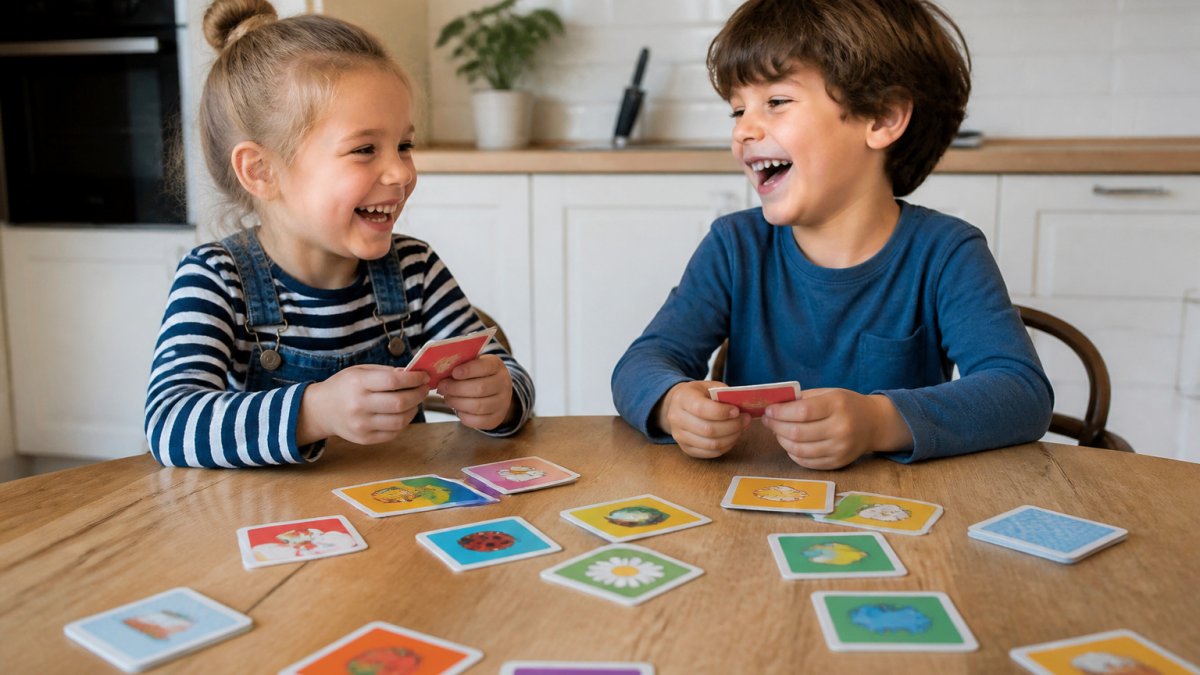
Classroom teachers and parents can also use card-based games for group play. For a screen-free option to try at home, you can explore the Remote-Control Wall-Climbing Gecko Toy for active, non-screen play.

Learning Games for Kids by Age
Age matters more than subject when you are choosing a game, but age alone is a blunt tool. A game that challenges a five-year-old can bore a nine-year-old, and a game built for older children can frustrate a younger one. The more useful question is: what developmental stage is this child in right now, and what does the game ask them to do?
Ages 3 to 5: pre-K and early learning
At this stage, children are building phonological awareness (hearing beginning sounds and rhymes), counting and one-to-one correspondence, and turn-taking. Games should have few rules, large pieces, and rounds that end in under 10 minutes.
- What to look for: picture-supported cards, matching and sorting mechanics, no reading required to play.
- Skills to target: beginning sounds, rhyming, counting to 20, color and shape recognition.
- Setup and duration: 1-3 minutes to set up; 5-10 minute rounds; 2-4 players.
Ages 5 to 8: kindergarten through grade 2
This is the widest band and the one where most learning games are sold. Children are decoding words, recognizing sight words on sight, and building addition and subtraction facts to 20. Games can now require reading, but the reading load should not crowd out the skill being practiced.
- What to look for: grade-level card decks, short rounds, immediate feedback, replayable levels.
- Skills to target: sight words, letter sounds, decoding two-syllable words, addition and subtraction facts.
- Setup and duration: 1-5 minutes to set up; 10-15 minute rounds; 2-4 players or one-on-one.
Ages 7 to 10: grades 2 through 4
Children in this band can handle multi-step rules, strategy, and losing gracefully, which makes cooperative and strategy games a good fit. Academic content shifts toward multiplication and division facts, multi-digit operations, and reading comprehension.
- What to look for: strategy board games, equation-building card games, games with a clear win condition and a short play time.
- Skills to target: multiplication and division facts, fractions as parts of a whole, vocabulary and comprehension.
- Setup and duration: 3-5 minutes to set up; 15-30 minute rounds; 2-4 players.
Ages 10 and up: grades 4 through 6
Older children often resist anything labeled "educational," so the game has to stand on its own as a game. Look for titles with real strategy, meaningful choices, and content that connects to what they are learning in school without announcing it.
- What to look for: strategy games with academic content baked in, trivia and quiz formats, games that reward explanation and reasoning.
- Skills to target: decimal and fraction operations, factors and multiples, early algebraic thinking, geography and history content.
- Setup and duration: 5-10 minutes to set up; 20-45 minute rounds; 2-5 players.
Mixed-age groups and siblings
Most families are not playing with same-age children, and most classrooms are not either. A few adaptations make mixed-age play work:
- Assign roles by ability, not age. A younger child can be the dealer, the scorekeeper, or the card-flipper while an older child plays the strategy role.
- Use handicap rules. Give younger players a head start, extra cards, or a peek at the answer.
- Pair up. Play in teams of one older and one younger child so the older child explains the reasoning, which is itself a strong learning activity.
Adapting games for different learning needs
A game-by-age guide is only useful if it also accounts for children who are not on a typical timeline. A few practical adaptations:
- For children with reading difficulties: choose games with picture-supported cards or read the cards aloud; the skill being practiced does not have to be reading.
- For children with attention or sensory needs: remove timers and buzzers, shorten rounds, and choose high-contrast, large-print cards.
- For multilingual learners: allow answers in either language while the child builds English vocabulary; pair with a peer who can model the words.
How to Choose Learning Games by Setup, Play Time and Skill Goal
Before you buy, answer three questions. First, what skill does your child need most right now: reading, number sense, focus, or social play? Second, how much time do you have for a session? Third, how much setup is realistic?
Watch out: a game that is too easy will not build skills, and one that is too hard will discourage your child.
Pick Your First Learning Game for Your Kids This Week
Start with one game that matches your child's current skill goal. If reading is the focus, the Squishyland Reading Adventure Board Game gives you a structured set of challenges for ages 3 to 8. If your child is learning sight words, the Sight Words Fidget Game Set is a hands-on way to practice. Play one 15-minute session this week, watch what your child enjoys, and build from there.
Frequently Asked Questions
What are some unique learning games for kids?
Unique learning games for kids include the Sight Words Fidget Game Set, which pairs word cards with rainbow pop mats for ages 5 to 8, and the Squishyland Reading Adventure Board Game, which covers beginning sounds through two-syllable decoding for ages 3 to 8. Both are designed for hands-on practice rather than screens. Pick a game that matches your child's current reading level, and play in short sessions of about 15 minutes so attention stays high and practice feels like fun rather than homework.
What games help kids learn while having fun?
Games that help kids learn while having fun usually combine a clear skill goal with short rounds, simple rules and visible progress. Card and board games that ask children to read words, sound out syllables or solve a challenge let them practice without noticing the drill. Sight-word games with fidget mats, for example, turn repetition into a physical action. Look for games that list the skill they target and the age range they suit, so the fun stays matched to what your child can actually do.
What are the best educational games for kids by age?
For ages 3 to 8, the Squishyland Reading Adventure Board Game suits Pre-K through Grade 2 reading skills, with play time of about 15 minutes for two to six players. For ages 5 to 8 in kindergarten through grade 2, the Sight Words Fidget Game Set offers card packs by grade level and works for two to four players or one-on-one practice. Older children may need different challenges, so check the age grading on each product before you buy and follow any safety warnings on the packaging.
Which learning games help kids practice math?
Math practice works well through games that ask children to count, compare or solve problems during play. Many board and card games include number challenges, and the best choices list the specific skills they cover. When shopping, confirm the math focus and age range in the product description. Keep sessions short, about 15 minutes, and use the game alongside your child's regular math instruction so the practice reinforces what they learn at school.
