
Last Updated: October 24, 2026
Quick Summary
Choose enrichment toys by matching them to your cat's natural play style and hunting behavior rather than buying what looks good on the shelf. Offer a mix of toys your cat can roll, pounce on, capture, bite, carry, and chase, then adjust for age, mobility, and frustration tolerance. Rotate three or four toys at a time and swap the lineup every week or two to keep novelty alive.
- Watch your cat for one week and note what it reacts to before buying any toy.
- The Ohio State University Indoor Pet Initiative recommends a mix covering six actions: roll, pounce, capture, bite, carry, chase.
- Puzzle feeders turn a five-minute meal into a twenty-minute problem for mental stimulation.
- Keep three or four toys out at a time and do a full swap every one to two weeks.
- Two to three five-minute play sessions a day beat a single twenty-minute block.
Table of Contents
- Start With Your Cat's Play Style, Not the Toy Aisle
- Match Enrichment Toys to Hunting Behavior
- Puzzle Feeders for Cats: Turning Meals Into Mental Stimulation
- Cat Toy Safety: Materials, Supervision, and What to Leave Out
- Build a Cat Toy Rotation and Play Schedule
- How to Tell If Your Enrichment Toys Are Actually Working
- Frequently Asked Questions
Start With Your Cat's Play Style, Not the Toy Aisle
Most owners buy enrichment toys for indoor cats the way they buy groceries: grab what looks good and hope for the best.
At Oddly Yours, we keep a simple rule: watch the cat before you shop.
The Ohio State University Indoor Pet Initiative recommends offering cats a mix of toys they can roll, pounce on, capture, bite, carry, and chase.
A Four-Question Decision Framework
Before you buy anything, answer these four questions about your individual cat. The answers narrow the shelf from dozens of options to a short list.
- What does your cat do when it spots a bug? Stalk low and freeze? Swat immediately? Walk away? That is its default prey sequence, and the toy should trigger the same stage.
- How old is your cat? Kittens under one year need fast, unpredictable movement and frequent short sessions. Adults between one and seven usually want a full stalk-chase-catch cycle. Cats over seven often prefer slower, ground-level toys and softer textures.
- Does your cat have any mobility limits? Arthritis, obesity, or a previous injury changes the answer. A cat that will not jump needs floor-level rollers and puzzle feeders, not high-flying wand work.
- How does your cat handle frustration? A cat that gives up fast does better with easy puzzle feeders and wand toys you control. A persistent cat can handle multi-step puzzles and battery toys that move on their own.
Match the Toy to the Play Style
Once you have those answers, the categories sort themselves:
- Chasers: feather wands, moving balls, anything that darts. Best for cats that stalk and sprint.
- Pouncers: soft toys they can grab and kick. Best for cats that ambush and bunny-kick.
- Thinkers: puzzle feeders and treat-dispensing toys. Best for cats that work for food or solve problems.
A cat can fall into more than one type. Most do. The point is to start with the strongest pattern and add variety from there.
Adjust for Age and Mobility
A gentle senior cat and a rough two-year-old need different builds. For seniors, look for lightweight toys that slide rather than fly, low-edge puzzle feeders, and soft kick toys that are easy to grab from a lying position. For kittens, expect short attention spans and rotate frequently. For cats with limited mobility, keep everything at floor level and avoid toys that require jumping or climbing.
A Quick Selection Checklist
Before any toy goes in the cart, run this check:
- Does it trigger at least one stage of the hunt your cat already shows?
- Is it appropriate for your cat's age and mobility?
- Can your cat succeed with it in the first few tries, or will it give up?
If a toy fails the checklist, it does not matter how good it looks on the shelf.
Match Enrichment Toys to Hunting Behavior
The best enrichment toys for indoor cats mimic prey. That's the whole trick. Indoor cats still carry the same hunting drive as outdoor cats, but they have nothing to hunt.
A review of environmental enrichment for indoor cats, published by Herron and colleagues in 2010, lists wand toys, battery-operated self-propelling toys that mimic prey, balls in a box or bathtub, and catnip-filled toys as core options.
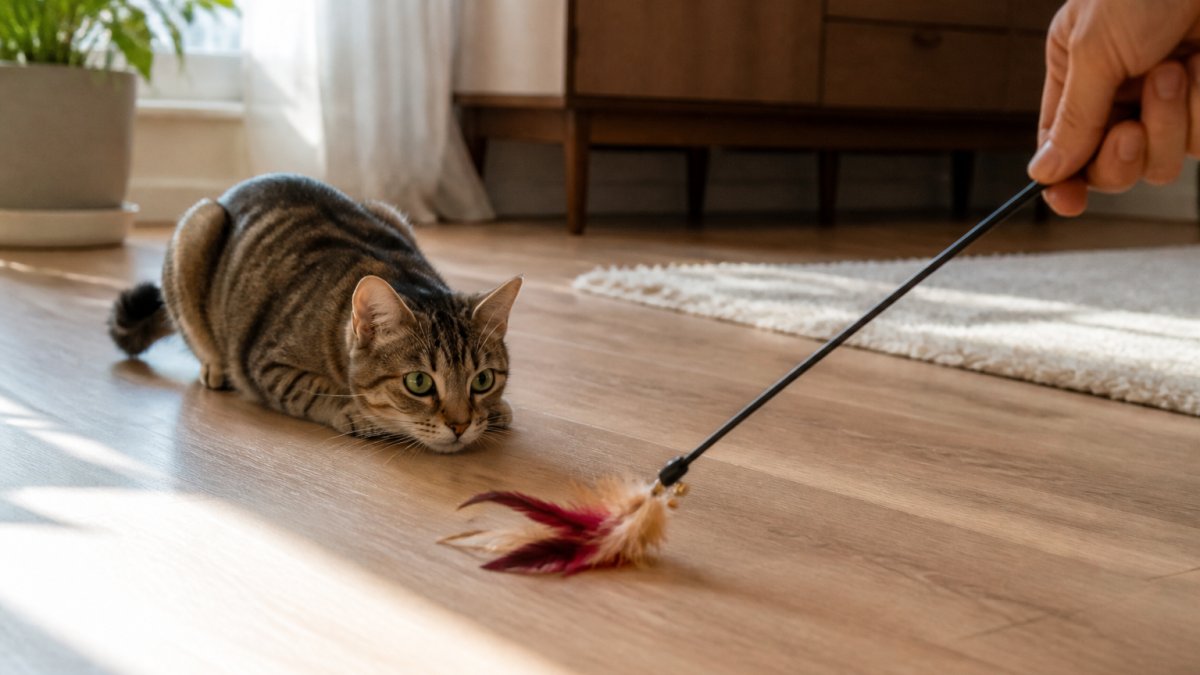
Each toy type targets a different stage of the hunt:
- Wand toys and teaser toys trigger stalking and chasing
- Self-moving toys trigger pouncing and batting
- Soft kick toys let cats bite and bunny-kick
Our Rechargeable Interactive Pet Ball rolls on its own, which suits cats that love chasing. For a wider pick, browse our toys and learning games.

Puzzle Feeders for Cats: Turning Meals Into Mental Stimulation
Puzzle feeders for cats turn a five-minute meal into a twenty-minute problem. That's mental stimulation with a purpose, and it costs you nothing extra in food.
The ASPCA's feline enrichment guide describes a simple DIY version: three or four toilet paper rolls, a box, and some kibble or treats.
Food enrichment does two jobs at once. It slows down fast eaters, and it gives a bored cat something to solve.
Ways to work it in:
- Swap one meal a day for a puzzle feeder
- Hide treats around the room for a scent hunt
- Use a treat-dispensing toy during your away hours
Cat Toy Safety: Materials, Supervision, and What to Leave Out
Cat toy safety comes down to three things: materials, size, and supervision. Get these wrong and a fun toy becomes a vet bill.
Here's what to check before any toy enters your home:
| Risk | What to Check | Why It Matters |
|---|---|---|
| Small parts | Nothing detachable under 1 inch | Choking hazard |
| Strings and ribbons | Put away after play | Swallowed string can block the gut |
| Bells and eyes | Stitched or glued securely | Loose pieces get eaten |
| Materials | Food-grade plastic, soft silicone | Safer for chewing |
| Battery toys | Screw-secured compartment | Prevents access to batteries |
A gentle senior cat and a rough two-year-old need different builds.
Rechargeable Interactive Pet Ball →
A few habits that keep play safe:
- Supervise wand and string play every time
- Rotate battery toys off when you leave
- Retire any toy showing cracks or loose pieces
Build a Cat Toy Rotation and Play Schedule
Cat toy rotation is the cheapest upgrade you can make. Cats get bored with the same toy sitting on the floor. Swap it out and it feels new again.
Keep three or four toys out at a time. Store the rest. Every week or two, switch the lineup. The goal is novelty without chaos: your cat should always have something to chase, something to solve, and something to grab.
A Sample Weekly Rotation
Here is a simple rotation you can copy. Adjust the toy types to match the play style you identified earlier.
| Day | Hands-on toy (out) | Independent toy (out) | Stored |
|---|---|---|---|
| Monday | Feather wand | Puzzle feeder | Kick toy, self-moving ball |
| Tuesday | Feather wand | Self-moving ball | Puzzle feeder, kick toy |
| Wednesday | Kick toy | Puzzle feeder | Feather wand, self-moving ball |
| Thursday | Kick toy | Self-moving ball | Feather wand, puzzle feeder |
| Friday | Feather wand | Puzzle feeder | Kick toy, self-moving ball |
| Saturday | Self-moving ball | Window perch | Feather wand, kick toy |
| Sunday | Rest or free choice | Rest or free choice | Rotate the full box |
At the end of the week, put the stored toys back in the box and pull out a different set. A full swap every one to two weeks is enough for most cats. If your cat loses interest faster, shorten the cycle.
A Daily Play Routine That Fits Real Life
A simple schedule looks like this:
- Morning (5-10 minutes): one short wand session before you leave or start work. End with a capture, let your cat catch the toy, so the hunt feels complete.
- Midday (independent): a puzzle feeder or hidden treats. This covers the hours when you are busy.
- Evening (5-10 minutes): self-moving toy or a second wand session while you cook dinner.
- Before bed (5 minutes): a calm session with a soft kick toy or a slow wand drag. This can reduce night yowling.
Short, frequent sessions beat one long one. Most practitioners find that two to three five-minute sessions a day work better than a single twenty-minute play block.
Match the Schedule to Your Cat
- Kittens: three to four short sessions a day, with frequent toy swaps.
- Adult cats: two to three sessions a day, plus one independent puzzle.
- Seniors: one or two gentle floor-level sessions, with softer toys and easier puzzles.
- Cats with limited mobility: keep play at floor level and use rolling or sliding toys instead of airborne ones.
Evaluate and Adjust
The 2014 owner survey by Strickler and colleagues asked owners about how often and how long they played with their cats and which toys they used.
Track results for two weeks. Note which toy, how long, and how engaged your cat seemed. If a toy sits untouched for a week, move it to the stored box and try a different type.
How to Tell If Your Enrichment Toys Are Actually Working
You'll know enrichment toys are working when your cat's behavior changes, not when the toy looks fun.
Good signs:
- Your cat plays longer each week
- It waits by the toy box at play time
- Fewer bored behaviors like over-grooming or night yowling
- It works at puzzle feeders instead of walking away
Bad signs:
- The toy sits untouched for a week
- Your cat loses interest in under a minute
- It shows stress or hides during play
If a toy fails, don't blame the cat. Interactive toys make up a big slice of the market, with Future Market Insights projecting 29.0% of the cat-toy product segment in 2026 coming from interactive options.
Track results for two weeks. Note which toy, how long, and how engaged your cat seemed. Patterns show up fast.
Boredom is the real problem, and it doesn't fix itself.
At Oddly Yours, we stock playful pet finds that make enrichment easy to start, from self-moving balls.
Browse the full pet collection and find the one your cat actually wants.
Frequently Asked Questions
Do cats get tired of playing with the same toys?
Yes, and that is why cat toy rotation matters. A toy left out for weeks stops being interesting because it no longer feels like prey. Put a few toys away in a closet and swap them out every week or two. When a toy reappears, it reads as new again. Pair rotation with short daily play sessions so your cat gets both novelty and predictable interaction. A rechargeable interactive ball can stay in the mix longer because its movement changes each time it rolls.
What toys are safe to leave out for cats unsupervised?
Leave out solid, single-piece toys with no strings, ribbons, feathers, or small parts that can be chewed off and swallowed. Balls, chasers, and treat-dispensing toys with no detachable pieces are good candidates. Wand toys, teaser toys, and anything on a cord should be put away after play. Check toys regularly for cracks, loose pieces, or exposed batteries. DIY enrichment setups using cardboard rolls and boxes work well, but supervise those too since cardboard gets shredded.
Are puzzle feeders good enrichment for indoor cats?
Puzzle feeders for cats are one of the highest-value enrichment toys you can buy. They turn a meal into a problem-solving task, which taps the same stalking and foraging behavior cats use in the wild. Start with an easy treat puzzle and move to harder ones as your cat figures them out. The Ohio State University Indoor Pet Initiative recommends offering toys cats can roll, pounce on, capture, bite, carry, and chase, and a food puzzle hits several of those at once.
How can I tell if my indoor cat is bored?
Watch for over-grooming, pacing, excessive meowing, weight gain, or a sudden interest in knocking things off shelves. A bored cat often sleeps more and interacts less. The fix is not more toys, it is the right toys plus a routine. Try ten minutes of wand play before meals and one puzzle feeder a day. If nothing changes after two weeks, talk to your vet, since some of these signs overlap with medical issues.
